Platelytix vs Cronometer: Why Nutrient Tracking Isn't Enough When You Have a Chronic Condition
Cronometer tracks up to 95 nutrients with verified data. It also has no idea what medications you're on, what your GFR is, or what stage of kidney disease you're in. For people managing chronic conditions, that gap is the whole problem.
Managing chronic illness and comorbid conditions means your nutrition isn't general anymore. What's safe to eat depends on your medications, your latest labs, and how your conditions interact with each other, often in ways that directly conflict.
Platelytix is built specifically for that complexity. It's a full food intelligence platform with integrated personalized meal plans built around your conditions and lab values. Other features include a recipe library filtered by condition, dietary and cuisine preferences, and a scoring engine that tells you whether a meal is safe for your specific health profile before you eat it. CookGuide takes this further by generating on-the-spot recipes adapted to your exact health metrics.
The scoring is where it starts.
See how your own meals score against your exact health profile: conditions, medications, and labs included.
Score a Meal Free: No Account NeededIn simple terms, Cronometer tracks what you eat. Platelytix tracks whether what you eat is safe given your health condition(s), medication(s), and lab(s). Here's how they compare.
Cronometer tracks up to 95 nutrients and compounds using lab-analyzed, verified data pulled from sources including the USDA and the Nutrition Coordinating Center, not crowdsourced user entries like some competitors. Its food database covers over 1.1 million entries. It tracks phosphorus, potassium, sodium, and protein accurately. It is used and recommended by dietitians and healthcare professionals worldwide.
If you want to know exactly how much phosphorus, potassium, or sodium you consumed today, Cronometer will give you a reliable answer. For someone with chronic kidney disease, that is not a small thing. In fact, most nutrition apps don't track phosphorus at all.
But here's the question Cronometer cannot answer: Is the phosphorus you ate today safe for your kidneys, given your current GFR, your serum potassium level, your CKD stage, and the medications you're on?
Tracking a number and knowing what that number means for your body are two different problems. Cronometer solves the first one exceptionally well. It doesn't attempt the second at all.
What Cronometer Does Not Do: Regardless of Condition
Before getting into specific conditions, it's worth being precise about what Cronometer is and isn't, based on its own documentation as of July 2026:
Cronometer has no medication field. There is no place to enter your prescription medications, and the app does not flag drug-food interactions. A Cronometer forum user asked about medication logging in 2021; the community confirmed there was no such feature. That has not changed.
Cronometer has no lab value fields. There is no place to enter your GFR, serum potassium, serum phosphorus, or A1C. Custom nutrient targets can be set manually by the user, but the app has no way to evaluate whether those targets are appropriate for your stage of disease.
Cronometer has no condition-aware scoring. It reports nutrients against general population targets or manually set targets. It does not produce a score, a recommendation, or an explanation. Numbers only: interpretation entirely up to the user.
Cronometer does not distinguish between organic and inorganic phosphorus. Phosphate additives in processed foods absorb at over 90% efficiency in the body. Natural phosphorus in whole foods absorbs at 40–60%. A processed hot dog and a fresh piece of salmon might show similar phosphorus numbers in Cronometer's output. In a CKD patient's body, they behave completely differently.
These aren't criticisms of Cronometer's design philosophy. They're accurate descriptions of what the tool is built to do, which is track nutrition, not interpret it for people with complex medical histories.
CKD and Diabetes: The Main Event
This is where the gap between nutrient tracking and condition-aware scoring is most consequential, because CKD and type II diabetes create competing dietary demands that no number alone can resolve.
Type II diabetes management prioritizes high-fiber, complex carbohydrates: whole grains, legumes, and vegetables that blunt the post-meal glucose spike. CKD management, particularly from Stage 3 onward, requires restricting potassium and phosphorus, both of which are abundant in whole grains and legumes. Brown rice is a better diabetes food than white rice by most standard metrics. For CKD Stage 3b, white rice is actually the safer choice because it carries a lower mineral load. This trade-off is not intuitive. It requires knowing both conditions simultaneously and reasoning about their conflict. Cronometer's nutrient totals cannot surface this. Platelytix scores against both simultaneously and explains the trade-off in the output.
Add Lisinopril, one of the most commonly prescribed medications for CKD, and the picture gets more complex. Lisinopril and other ACE inhibitors independently raise serum potassium by reducing aldosterone-mediated excretion. A person eating 2,500mg of dietary potassium while on Lisinopril has a meaningfully different hyperkalemia risk than a person eating the same amount without it. Cronometer cannot make this distinction because it has no medication field. Platelytix flags the ACE inhibitor-potassium interaction automatically when Lisinopril is in the medication profile.
Here's what this looks like in practice. A person with CKD Stage 3b, GFR 38, serum potassium 5.0 mEq/L, taking Lisinopril alongside Ozempic, runs grilled salmon with white rice and roasted vegetables through Platelytix. The same meal that looks healthy on paper scores 42 out of 100: Not Recommended, because the serum phosphorus is already elevated, the vegetable potassium load compounds the Lisinopril risk, and semaglutide's effect on gastric emptying makes the meal volume a flag for nausea per ADA 2025 prescribing guidance.
The same meal for a Stage 3a patient with GFR 55 and serum K 4.8 scores 62: Caution. Same food. Different body. Different score.
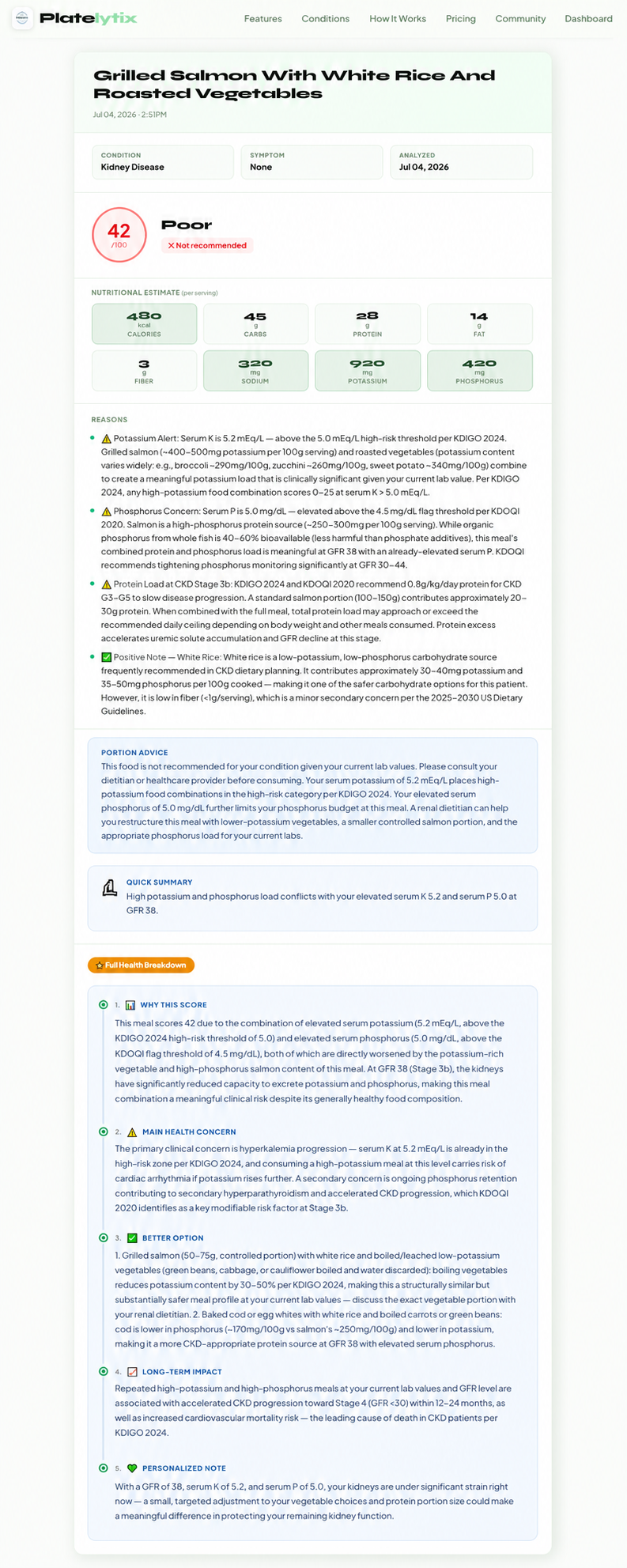
Score: 42/100. Not Recommended. Elevated serum phosphorus, compounded potassium risk from Lisinopril, and GLP-1 gastric emptying flag.
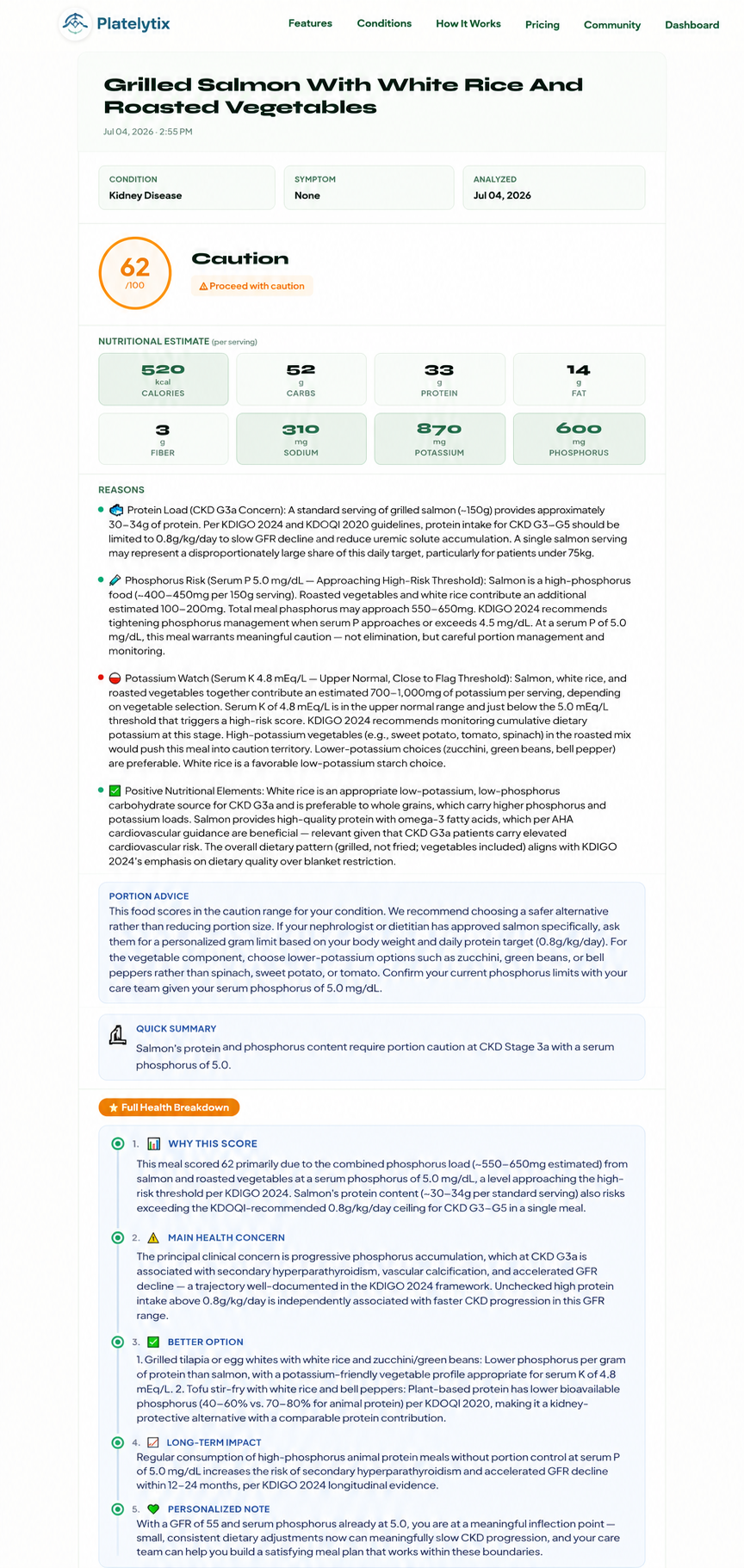
Score: 62/100. Caution. Same meal, better kidney function and labs within safer range. Risk profile shifts entirely.
Cronometer would show both patients the same nutrient totals. The clinical picture between them is entirely different.
For the CKD-diabetes overlap, Platelytix also accounts for:
- Protein targets that shift based on CKD stage (0.8g/kg/day for G3–G5 per KDOQI 2020, reversing upward for dialysis patients)
- Phosphate binder timing reminders when phosphorus-containing foods are analyzed
- A1C-aware glycemic scoring that tightens as A1C rises
- Inorganic vs organic phosphorus distinction, since processed food phosphate additives are the most dangerous source and don't appear on nutrition labels
GLP-1 Users: Ozempic, Wegovy, Mounjaro
Cronometer has no awareness of GLP-1 medications. It cannot adjust protein targets to reflect the muscle preservation priority on semaglutide therapy. It cannot flag that high-fat or high-volume meals worsen nausea when gastric emptying is already slowed. It cannot identify the nutrient depletion risks, such as vitamin D, iron, B vitamins, and calcium, that research now consistently links to GLP-1 therapy. A 2026 analysis of 480,825 GLP-1 users found that nearly 1 in 8 developed a measurable nutritional deficiency within six months of starting treatment.
Platelytix accounts for all of this. When semaglutide or any other GLP-1 medication is in the profile, meal scoring reflects the gastric emptying constraints, protein priority, and micronutrient depletion risks alongside any comorbid conditions. For someone on Ozempic who also has CKD (a combination the FDA specifically recognized when it approved semaglutide for kidney protection in type 2 diabetes in January 2025), the scoring accounts for both sets of constraints simultaneously.
Hypertension and Heart Disease
Cronometer tracks sodium. It cannot tell you that the sodium restriction you're following may be too aggressive given that you're also on furosemide, a loop diuretic that already causes the kidneys to excrete sodium. That combination can drive blood sodium dangerously low (hyponatremia), with symptoms that are easily dismissed as fatigue or aging. Cronometer has no way to flag this because it has no medication list.
For statin users managing high cholesterol alongside heart disease, Cronometer cannot warn that grapefruit and grapefruit juice interfere with how atorvastatin and simvastatin are metabolized, a well-documented CYP3A4 inhibition interaction. Platelytix flags this automatically when those medications appear in the profile.
For the DASH diet patterns recommended for both hypertension and heart disease, Platelytix scores meals against AHA 2026 dietary guidance and assigns score bonuses to foods aligned with cardiovascular risk reduction, not just a raw sodium number against a generic population target.
IBS and Low-FODMAP Diets
Cronometer tracks fiber. It does not track FODMAP status. It cannot tell you that the garlic and onion in a meal are high-FODMAP even at small amounts, or that a serving of broccoli shifts from low to high FODMAP based purely on portion size. These distinctions are the difference between an IBS-safe meal and an IBS-triggering one, and they don't appear anywhere in a nutrient breakdown.
Platelytix scores meals against Monash University low-FODMAP guidelines, including serving-size-dependent thresholds. For someone managing IBS alongside another condition, say hypertension or diabetes, those constraints are cross-referenced simultaneously in the score.
GERD and Acid Reflux
Cronometer tracks fat content. It does not flag that coffee, tomato, citrus, chocolate, peppermint, and alcohol are established GERD triggers regardless of their macronutrient profile. A meal can be nutritionally balanced by every standard Cronometer tracks and still be a reliable reflux trigger for someone with GERD.
Platelytix scores against ACG GERD guidelines and flags trigger foods specifically, with an additional note on portion size, since even GERD-safe foods become risky in large volumes when esophageal pressure is a concern.
Hypothyroidism and Levothyroxine
Cronometer has no Levothyroxine awareness. It cannot flag that calcium-rich foods, high-fiber foods, and soy all reduce how much Levothyroxine the body absorbs when consumed at the wrong time, and that the medication should be taken 30–60 minutes before eating for this reason. It cannot flag that raw cruciferous vegetables carry goitrogenic compounds (reduced significantly by cooking) that can interfere with thyroid hormone production.
Platelytix includes Levothyroxine timing notes in meal analysis and flags goitrogen-containing foods with a distinction between raw and cooked preparations, since cooking substantially reduces the concern.
Side-by-Side Summary
| Feature | Cronometer | Platelytix |
|---|---|---|
| Nutrient tracking accuracy | Excellent: verified, lab-analyzed data | Condition-scored across 150+ guideline-referenced meals |
| Food database size | 1.1M+ verified entries | Condition-scored meals + recipe library |
| Phosphorus tracking | Yes: total phosphorus only | Yes: distinguishes organic vs inorganic |
| Medication field | No | Yes: drug-food interactions flagged automatically |
| Lab values (GFR, serum K, A1C) | No | Yes: score adjusts to your actual labs |
| CKD stage awareness | No | Yes: scoring shifts by stage |
| Meal scoring | No | Yes: 0–100 with guideline-referenced reasoning |
| Condition-specific guidelines | No | Yes: KDOQI, KDIGO, ADA, AHA, Monash, ACG |
| Comorbidity stacking | No | Yes: multiple conditions scored simultaneously |
| Drug-food interactions | No | Yes: ACE inhibitors, statins, diuretics, Levothyroxine, GLP-1 |
| Recipe library | No | Yes: 150+ globally diverse, condition-filtered |
| Meal plan generation | No | Yes: based on your health metrics, dietary and cuisine preferences |
| On-demand recipe generation (CookGuide) | No | Yes: generates a recipe in real time built around your conditions, medications, and labs |
| Best for | General healthy population, athletes, dietitians tracking intake | People managing chronic conditions, multiple medications, or complex lab-dependent dietary needs |
Set up your health profile and let CookGuide build meals around your conditions, medications, and labs, not generic recipes.
Try CookGuide Set Up Your Health ProfileThe Bottom Line
Cronometer is the right tool if you want to know what you ate. It is one of the most accurate nutrient tracking tools available and deserves its reputation in the nutrition tracking community.
Platelytix is the right tool if you want to know whether what you ate was safe for your specific body, given your conditions, your medications, your lab values, and where you are in your disease progression.
For healthy people optimizing performance or monitoring general nutrition, Cronometer's approach is entirely sufficient. For people managing CKD, diabetes, GLP-1 therapy, hypertension, IBS, GERD, hypothyroidism, or any combination of these, the additional layer Platelytix provides is the layer that determines whether a meal is a good choice or an unrecognized risk.
They are not competing for the same user. They are solving different problems. If your health situation is complex, you need the tool that was built for complexity.
Frequently Asked Questions
- Cronometer.com. Features, subscription types, and CKD support documentation. Verified July 2026.
- Cronometer Blog. "Managing Chronic Kidney Disease on Cronometer." April 22, 2025.
- National Kidney Foundation. KDOQI Clinical Practice Guidelines for CKD, 2020.
- KDIGO 2024 CKD Evaluation and Management Guidelines.
- American Diabetes Association. Standards of Care in Diabetes — 2025 & 2026.
- American Heart Association Dietary Guidelines, 2026.
- Monash University Low FODMAP Diet Guidelines.
- American College of Gastroenterology (ACG) GERD Guidelines.
- Urbina et al. Clinical Obesity, February 2026: review of 480,825 GLP-1 users.
- FDA approval of semaglutide for CKD in type 2 diabetes, January 2025. Based on FLOW trial (NEJM, 2024).
- KidneyPal Blog. "Best Kidney Diet Apps in 2026." February 14, 2026.