MyFitnessPal vs Platelytix: Which Nutrition App Is Actually Built for Chronic Conditions and Medications?
MyFitnessPal tracks what you eat. Platelytix tracks what's safe to eat given your conditions, your lab values, and every medication you're on.
Picture an app that completely understands your current health and tells you exactly what impact a meal can have on your A1C, your potassium, or even your phosphorus levels before you eat it. An app that removes the guesswork so common in generic meal and fitness trackers. An app that understands a meal deemed healthy by most may not be safe for you specifically because you're on Lisinopril, or your GFR just dropped, or your A1C is climbing.
That's exactly what Platelytix does. It uses your conditions, medications, allergies, and lab values to assess whether a meal is safe or potentially harmful for your health profile.
Beyond scoring, Platelytix includes a recipe library filtered by condition, dietary preference, and cuisine. Additionally, the platform includes a medication-aware weekly meal planning and CookGuide which generates on-the-spot recipes adapted to your exact health metrics.
The meal score is where most people start.
See how your own meals score against your exact health profile: conditions, medications, and labs included.
Score a Meal Free. No Account NeededHere's how Platelytix compares to MyFitnessPal and what each tool is actually built to do.
If you've searched for a nutrition tracking app, you've likely already come across MyFitnessPal. With over 280 million members and a food database of 20 million items, it's the most widely used nutrition tracker in the world. For general wellness, calorie counting, and fitness goals, it's genuinely excellent.
But if you're managing a chronic condition alongside a medication list, the comparison changes significantly.
This article breaks down both tools honestly: what each does well, where each falls short, and who should use which.
What MyFitnessPal Does Well
MyFitnessPal was built for the general population managing weight, fitness, and overall nutrition. At that, it excels.
Its food database is unmatched: 20 million items, barcode scanning, voice logging, photo logging, and recipe import. In April 2026, it launched a dedicated GLP-1 Support feature that lets Ozempic and Wegovy users log their injection dose, track side effects, and view medication alongside their nutrition on a single screen. That's a meaningful addition for a very large and growing user group.
MyFitnessPal supports a wide range of dietary preferences in its setup: low-carb, Mediterranean, vegetarian, keto, and others. It integrates with over 40 fitness trackers and health apps. Premium features include customized macro targets, meal scanning, and calorie comparison tools.
For someone without chronic conditions or a medication stack, MyFitnessPal is one of the best tools available.
Where MyFitnessPal Falls Short for Chronic Conditions
The gaps become clear the moment a chronic condition or medication enters the picture.
MyFitnessPal does not know what medications you're taking. Its GLP-1 Support feature logs that you took a dose of Ozempic but it cannot tell you that the smoothie you just logged provides 4g of protein against a clinical minimum of 20–30g per meal for GLP-1 therapy. It cannot flag that your fruit bowl is pushing potassium high if you're on an ACE inhibitor. It cannot warn you that the salt substitute you're using is dangerous when combined with Lisinopril and CKD.
It does not track phosphorus, a critical nutrient for CKD patients. Per KidneyPal's own analysis, a CKD patient following MyFitnessPal's default sodium target of 2,300mg would be eating 800mg above their actual recommended limit for Stage 4 CKD every single day.
It does not account for comorbidity stacking. The dietary guidance for someone managing both CKD and diabetes simultaneously is fundamentally different from the guidance for either condition alone: the protein limits conflict, the potassium guidance conflicts, and the sodium targets differ. MyFitnessPal has no mechanism to reason across multiple conditions simultaneously.
It does not incorporate lab values. Whether your serum potassium is 3.8 or 5.2 mEq/L changes everything about which foods are appropriate. MyFitnessPal has no field for your GFR, your A1C, your serum potassium, or your blood pressure.
What Platelytix Does Differently
Platelytix is built specifically for the gap between general nutrition tracking and clinical reality.
When you set up a Platelytix profile, you enter:
- Primary condition and comorbidities: for example, Type 2 Diabetes as the primary condition with Hypertension as a comorbidity. Both are applied to every score simultaneously.
- Full medication list: common medications are pre-populated by category: CKD, diabetes, hypertension, thyroid, GI, cardiovascular, supplements, and others. If Semaglutide (Ozempic) is listed, Platelytix applies GLP-1-specific clinical priorities: protein adequacy, fiber targets, and micronutrient monitoring, reflecting whether semaglutide was prescribed for Type 2 Diabetes management or weight loss, without conflating the two.
- Lab values: GFR, serum potassium, phosphorus, albumin, PTH, A1C, fasting glucose, TSH, and blood pressure. These override stage-based estimates with your actual numbers.
- Health goals: Lose Weight, Gain Weight, Build Muscle, Manage Condition, Reduce Inflammation, or Maintain Weight, with goal intensity (Gradual, Moderate, or Aggressive). A goal of "Lose Weight" on a GLP-1 profile triggers protein prioritization at every meal to protect lean mass, something MyFitnessPal's calorie-centric goal framework has no equivalent for.
- Dietary and cuisine preferences: 14 dietary categories and 11 cuisine categories, applied to meal plan generation and recipe filtering.
- CookGuide: generates on-the-spot recipes adapted to your exact health metrics, medications, and labs, for when you don't know what to make.
Not sure what to cook? CookGuide builds a meal in real time around your full health profile: medications, conditions, and labs included.
Try CookGuideThe scoring engine applies the most current clinical guidelines:
KDIGO 2024 for CKD: including GFR-tiered electrolyte thresholds, the distinction between inorganic phosphorus (90–100% bioavailable from food additives) vs organic phosphorus (40–60% from whole foods), and dialysis-specific protein considerations.
ADA 2025 for diabetes: including A1C-tiered glycemic scoring, SGLT2 inhibitor interactions, and GLP-1 co-management.
AHA 2026 for cardiovascular conditions: sodium thresholds, DASH pattern alignment, and saturated fat scoring.
ACLM/ASN/OMA/TOS 2025 Joint Advisory for GLP-1 therapy: protein prioritization at 20–30g per meal, fiber adequacy for constipation prevention, and the six specific micronutrient deficiency categories documented in the clinical literature (iron, Vitamin D, B12, calcium, thiamine, magnesium).
ACG guidelines for GERD and IBS: FODMAP scoring, acid-trigger identification, and portion-size flagging for GERD.
Medication interaction flags are built in for 17 specific drug-food combinations, including ACE inhibitors and potassium, phosphate binders and meal timing, Warfarin and Vitamin K consistency, Levothyroxine and calcium/fiber timing, statins and grapefruit, and GLP-1 protein priority.
Conditions Platelytix Supports
Platelytix supports scoring and meal analysis for:
- Chronic Kidney Disease (Stage 1 through Stage 5 and dialysis)
- Type 1 and Type 2 Diabetes
- Hypertension
- Heart Disease
- GERD / Acid Reflux
- IBS
- Hypothyroidism
- High Cholesterol
- Obesity / Weight Management (including GLP-1 therapy)
- Celiac Disease
- Asthma
And critically, any combination of the above simultaneously.
Dietary and Cuisine Preferences
Platelytix supports the following dietary preferences: Omnivore, Vegetarian, Vegan, Pescatarian, Keto, Paleo, Halal, Kosher, Gluten-Free, Dairy-Free, High Protein, Low Protein, Low Carb, and GLP-1 / Ozempic.
Cuisine preferences include: West African, East African, Caribbean, South Asian, East Asian, Southeast Asian, Middle Eastern, Latin American, Mediterranean, American, and European.
These preferences influence meal plan generation, recipe filtering, and the context when generating scoring insights, not just recipe labels.
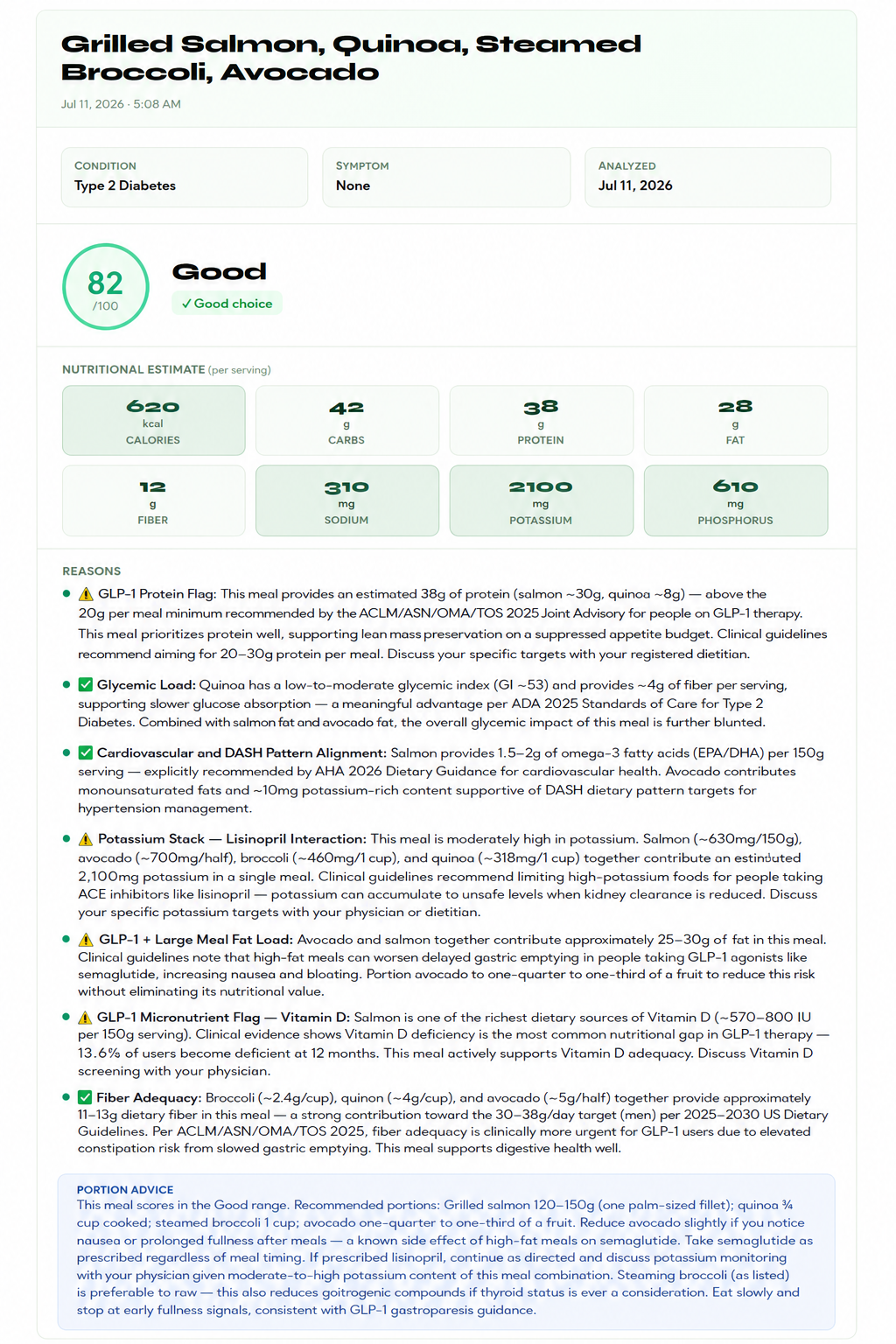
Real Platelytix output: scored against the full medication and condition stack, not generic nutrition guidelines. Meal: Grilled salmon, quinoa, broccoli. Profile: Type 2 Diabetes + Hypertension + Semaglutide (Ozempic) + Lisinopril. Health goal: Manage Condition.
Head-to-Head Comparison
| Feature | MyFitnessPal | Platelytix |
|---|---|---|
| Food database | 20 million items | Any meal entered by name or description, scored against your full health profile |
| Medication awareness | GLP-1 dose logging only | Full medication list, 17 drug-food interaction flags |
| Lab value integration | None | GFR, K, P, albumin, PTH, A1C, TSH, blood pressure |
| Phosphorus tracking | Not available | Tracked with inorganic vs organic distinction |
| Comorbidity stacking | None | All conditions scored simultaneously |
| Health goals | Calorie and fitness targets only | Condition-aware goals (lose weight, build muscle, manage condition, reduce inflammation) with goal intensity |
| Dietary preferences | Multiple options | 14 dietary preference categories |
| Cuisine preferences | Not condition-specific | 11 cuisine categories |
| Fitness tracking | 40+ integrations | Not a fitness app |
| Price | Free + $19.99/month premium | $7.99/month or $59.99/year |
Who Should Use Which
Use MyFitnessPal if: You're managing general wellness, weight, or fitness without a chronic condition or medication stack. It's one of the best tools available for that use case.
Use Platelytix if: You're managing one or more chronic conditions, are on medications with known food interactions, have lab values that affect your dietary targets, or are on GLP-1 therapy and want scoring that reflects clinical protein and micronutrient priorities, not just calorie counts.
Use both if: You want MyFitnessPal's database size and fitness integrations for general logging, and Platelytix for condition-specific scoring and medication awareness on meals that matter most.
Try It
Set up your full health profile and see exactly how your meals score for you, not a generic user.
Set Up Your Health Profile Score a MealDisclaimer: This article is for educational purposes only and does not constitute medical advice. Always consult your physician, nephrologist, or registered dietitian before making dietary changes.