KidneyPal vs Platelytix: Which CKD App Is Built for Your Full Health Picture?
KidneyPal was purpose-built for kidney disease. Platelytix was built for kidney disease alongside everything else — the medications, the comorbidities, and the lab values that change what's safe to eat every day.
For many people living with CKD, one of the biggest daily challenges is knowing what to eat. You're constantly worrying about how much potassium or phosphorus in a meal may affect your next lab results. Understanding that predicament firsthand was one of the core reasons I built Platelytix, a tool designed to eliminate most of that guesswork and give you clarity around food that most apps simply can't.
KidneyPal is built for CKD. Platelytix is built for CKD alongside everything else: the ACE inhibitor in your medication list, the diabetes diagnosis, the elevated serum potassium from last Tuesday's labs. Beyond scoring, Platelytix generates personalized weekly meal plans filtered by your CKD stage and cuisine preference, flags phosphate binder timing with every relevant meal, and includes CookGuide for on-demand recipe adaptation built around your exact profile.
The score is the entry point.
See how your own meals score against your exact CKD profile: stage, labs, and medications included.
Score a Meal Free: No Account NeededHere's how Platelytix compares to KidneyPal and where each tool is built to take you.
KidneyPal is one of the most thoughtfully built CKD-specific apps available in 2026. If you have CKD and no other comorbid conditions or medications to account for, it's worth serious consideration.
But CKD rarely arrives alone. Most people managing kidney disease are also managing hypertension, diabetes, heart disease, or some combination, each with its own dietary requirements, medication list, and conflict with CKD guidance. That's where the comparison between these two tools gets interesting.
What KidneyPal Does Well
KidneyPal was built specifically for CKD and it shows. Its core feature set is strong and directly relevant to kidney patients.
It tracks the four nutrients that matter most in CKD: sodium, potassium, phosphorus, and protein, with daily limits personalized to your CKD stage from Stage 1 through Stage 5 and dialysis. That stage-specific personalization is important: what's safe at Stage 2 is genuinely different from what's safe at Stage 4, and KidneyPal accounts for this.
Its phosphorus additive detection is a meaningful differentiator. Inorganic phosphorus from food additives (sodium tripolyphosphate, phosphoric acid, sodium phosphate) is 90–100% bioavailable, compared to 40–60% for phosphorus from whole foods. KidneyPal's scanner attempts to identify these additives in processed foods. That's a gap most general nutrition apps miss entirely.
The photo, voice, text, and barcode logging options are practical. The kidney-safe recipe library, recipe URL import, and PDF doctor reports round out a solid CKD-focused feature set. App Store and Play Store reviews reflect genuine positive user experiences, particularly from patients whose labs improved after using it consistently.
Where KidneyPal Falls Short
The limitation is scope. By design, KidneyPal is a CKD tool, and that precision is its strength for a single-condition patient and its constraint for everyone else.
Medication interactions are not part of the KidneyPal feature set. If you're on Lisinopril or Ramipril alongside CKD, the potassium retention effect of ACE inhibitors compounds your kidney-driven potassium risk significantly. KidneyPal tracks your potassium intake against your CKD stage budget, but it cannot tell you that salt substitutes become acutely dangerous on this combination, or that spironolactone stacked on top raises the risk further.
Comorbid conditions beyond hypertension are not scored simultaneously. KidneyPal's setup acknowledges high blood pressure as a secondary condition, but if you're managing CKD and Type 2 Diabetes together, the protein conflict is one of the most clinically significant dietary dilemmas patients face: CKD guidelines say restrict protein, while diabetes management and GLP-1 therapy say prioritize it. KidneyPal has no mechanism to reason across both simultaneously.
Lab values beyond CKD stage are not integrated. Serum potassium level, serum phosphorus, albumin, GFR (the actual number, not just the stage), A1C, and blood pressure readings all change which foods are appropriate on a given day. Platelytix allows you to enter and apply all of these values to your scoring.
GLP-1 therapy on CKD is unaddressed. A CKD patient on Ozempic faces a specific and clinically documented conflict: GLP-1 guidelines recommend protein prioritization at 20–30g per meal to prevent lean mass loss, while CKD Stage 3–5 guidelines recommend protein restriction at 0.8g/kg/day to protect kidney function. This conflict requires a judgment call that accounts for both conditions simultaneously. Neither app resolves it definitively, but Platelytix flags both considerations together and references the relevant guidelines by name.
What Platelytix Adds for CKD Patients
For CKD specifically, Platelytix applies KDIGO 2024 and KDOQI 2020 guidelines including:
GFR-tiered electrolyte thresholds: serum potassium above 5.0 mEq/L triggers an aggressive scoring downgrade for any high-potassium food. Serum phosphorus above 5.5 mg/dL does the same for phosphorus-containing foods. These lab-level adjustments go beyond what stage alone can determine.
Inorganic vs organic phosphorus distinction: same as KidneyPal, Platelytix distinguishes bioavailability between food additive phosphorus and whole-food phosphorus when scoring.
Dialysis-specific protein guidance: dialysis patients lose amino acids during sessions and have higher protein needs than pre-dialysis CKD patients. The scoring engine accounts for this distinction rather than applying blanket protein restriction.
Phosphate binder timing reminders: when phosphate binder medications (Sevelamer, PhosLo, Fosrenol, Lanthanum) are in your medication list, the scoring output reminds you to take them with the first bite of every meal containing protein or dairy, not before, not after. This is a clinical timing issue that affects medication effectiveness and most patients are never clearly told about it at point of prescribing.
ACE inhibitor / ARB interaction flags: if Lisinopril, Ramipril, Losartan, Valsartan, or any other RAAS-blocking agent is in your medication list alongside CKD, potassium-containing foods are flagged with the compound risk explained in plain language.
Comorbidity stacking: every condition in your profile is applied simultaneously. CKD + diabetes, CKD + hypertension, CKD + heart disease, and any further combination all influence the score together.
CookGuide: generates personalized recipe instructions on demand, adapted to your full CKD profile. If a CKD Stage 3a patient wants to make lasagna but needs substitutions for high-phosphorus dairy and high-potassium tomato sauce, CookGuide generates the adapted recipe, specifies exact portion sizes with visual guidance, and flags any ingredient that conflicts with their medication list or lab values. It will not allow substitutions that would compromise clinical safety. If a user pushes beyond recommended limits, CookGuide explains why and redirects to their care team where appropriate.
See CookGuide adapt a recipe to your exact CKD profile: substitutions, portions, and medication-safe swaps included.
Try CookGuide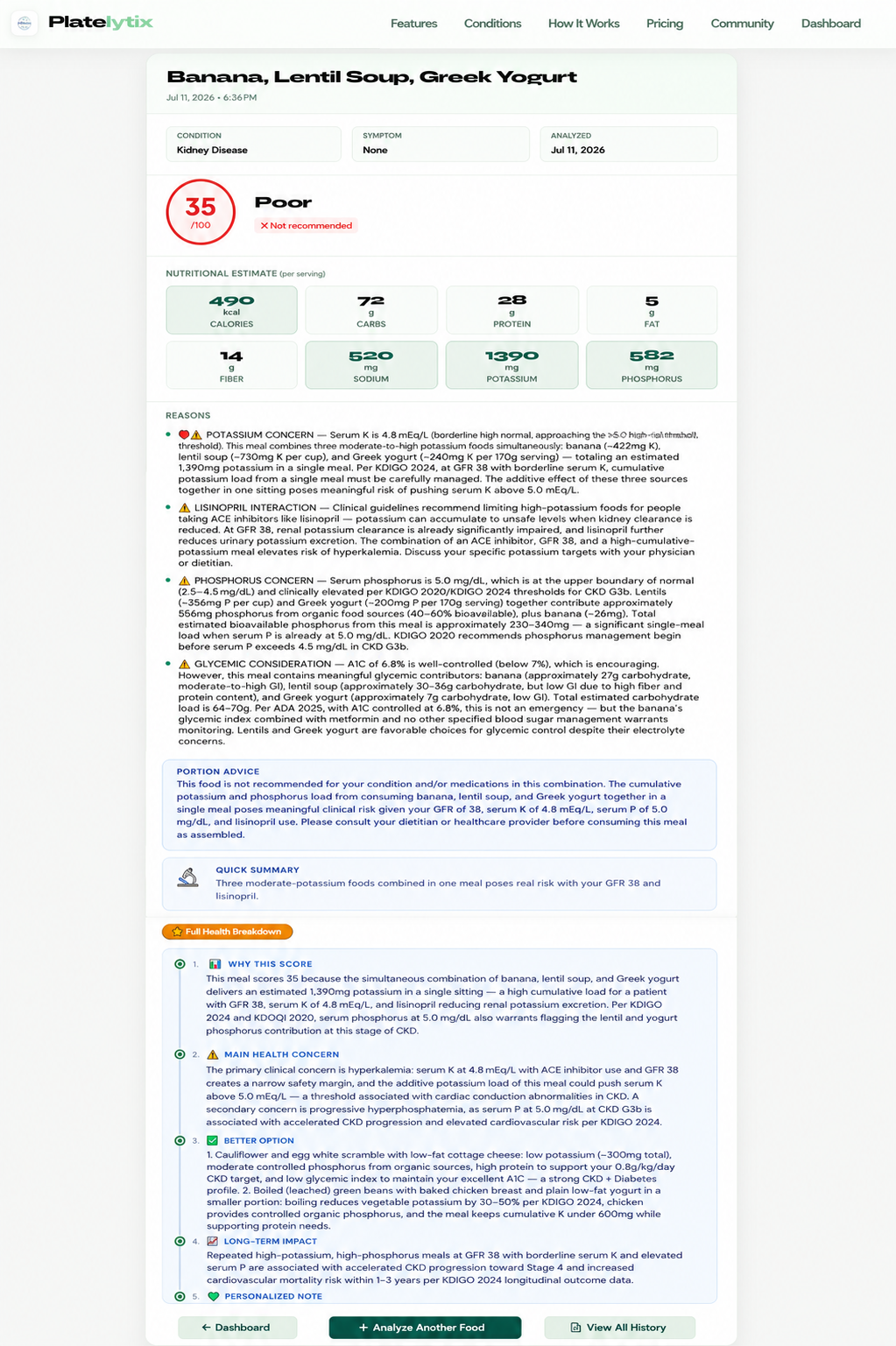
Real Platelytix output: banana, lentil soup, Greek yogurt. Profile: CKD Stage 3b + Type 2 Diabetes + Lisinopril. Three foods that look healthy. Each one flagged for a different reason on this comorbid profile.
Head-to-Head Comparison
| Feature | KidneyPal | Platelytix |
|---|---|---|
| CKD stage personalization | ✓ Stage 1–5 + dialysis | ✓ Stage 1–5 + dialysis |
| Phosphorus additive detection | ✓ Yes | ✓ Yes |
| Medication interaction flags | None | 17 specific drug-food interactions |
| Lab value integration | CKD stage only | GFR, serum K, serum P, albumin, PTH, A1C, TSH, blood pressure |
| Comorbid condition scoring | Hypertension acknowledgment only | Full simultaneous stack: diabetes, HTN, heart disease, and more |
| GLP-1 therapy awareness | None | Full protein and micronutrient flags per ACLM 2025 |
| Phosphate binder timing | None | Flagged with every relevant meal |
| Personalized recipe guidance | Kidney-safe recipe library | CookGuide: on-demand adapted recipes by profile |
| Doctor PDF report | Yes | In development |
| Photo meal scanning | Yes | Text and description based |
| Price | ~$4/month (billed annually) | $7.99/month or $59.99/year (~$5/month) |
Who Should Use Which
Use KidneyPal if: You have CKD as your primary and essentially only condition, no significant medication interactions to account for, and want photo scanning and recipe URL import as part of your workflow. Its CKD-specific depth is excellent for this profile.
Use Platelytix if: You have CKD alongside any comorbid conditions such as diabetes, hypertension, or heart disease, or are on medications with documented food interactions, or have lab values that affect your specific targets beyond what stage alone determines.
Use both if: You want KidneyPal's photo scanning for quick daily logging, and Platelytix for deeper scoring when you're evaluating new foods, planning meals around a medication change, or managing a comorbid condition flare.
Set up your full CKD profile: stage, labs, and medications, and see exactly how your meals score for you.
Set Up Your Health Profile Score a MealDisclaimer: This article is for educational purposes only and does not constitute medical advice. Always consult your nephrologist or renal dietitian before making dietary changes.